


Plus Ultra
The *Plus Ultra* was the Spanish Military Aviation (W-12) seaplane—bearing the registration M-MWAL—that made the first-ever flight between Spain and South America; it departed on January 22, 1926, from the Calzadilla Dock in Palos de la Frontera (Huelva) bound for Buenos Aires, arriving there on February 10 of that same year.
The Dornier Do J Wal is considered the most important aircraft designed by Dornier in the early 1920s. Its spacious, all-metal, double-stepped hull incorporated streamlined sponsons to provide greater stability on the water. The cost of the aircraft—including navigation instruments, spare parts, fuel, and travel allowances—totaled 415,132 pesetas.
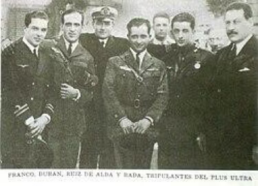
The seaplane’s four-man crew consisted of Commander Ramón Franco, Captain Julio Ruiz de Alda, Lieutenant Juan Manuel Durán, and Mechanic Sergeant Pablo Rada, all of whom were Spanish.
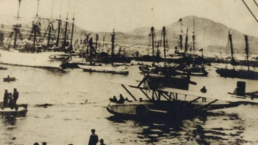
The first leg of the journey began at the Calzadilla Dock in Palos de la Frontera (Huelva)—with the seaplane taking off opposite La Rábida at the mouth of the Tinto River—and ended eight hours later at dusk, when the aircraft touched down in the Port of La Luz, in the bay of Las Palmas de Gran Canaria.
Prior to takeoff, the aircraft underwent a testing phase during which a stowaway— the journalist Emilio Herrero Mazorra, from Cantabria—was discovered on board during the flight from Mar Menor to Palos de la Frontera.
On the 26th, the *Plus Ultra* took off from Gando Bay in the municipality of Telde (Las Palmas)—on the island’s east coast—bound for Praia on Santiago Island (Cape Verde), the end of the second leg, which lasted nine hours and fifty minutes. In Praia, it was necessary to reduce the aircraft’s load to the absolute limit, resulting in Naval Ensign Juan Manuel Durán González remaining behind.
The next leg was scheduled to take place between the Cape Verde Islands and Pernambuco; however, strong headwinds blew the *Plus Ultra* off course and forced an unscheduled landing on the island of Fernando de Noronha. Upon inspection, the fuel tanks were found to be nearly empty, making refueling necessary. This leg covered 2,305 km over open water. The radio direction finder— used for the first time on this type of flight—enabled the aircraft to stay on the correct course without deviation during the longest leg of the journey.
On the 31st, they covered the 540 km separating the Fernando de Noronha Islands from the coast of Pernambuco, already on the American mainland. This leg was not without its risks, as, when more than one hundred kilometers remained, the rear propeller broke and had to be repaired in mid-flight. This added more than an hour to the expected crossing time.
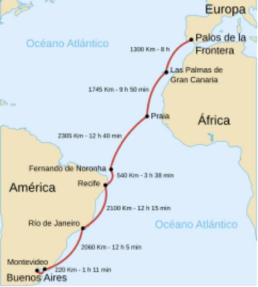
In Pernambuco, the crew rested to carry out repairs. On February 4th, the Plus Ultra arrived in Rio de Janeiro (Brazil) (2100 km)
in twelve hours and fifteen minutes. The aviators received an enthusiastic welcome. On the 9th, they arrived in Montevideo, and the following day, Franco, Ruiz de Alda, Durán, and Rada arrived in Buenos Aires, acclaimed by a huge crowd. The arrival of the Spanish aviators would be remembered for a long time in Argentina. It was a momentous event for the Río de la Plata countries and for Spain; hailed as a great feat by newspapers around the world.
The flight, which was a resounding success from a technical point of view, covered 10,270 km in 59 hours and 30 minutes (at an average speed of 172 km/h).